Walk into any big-box home improvement store in Denver and you can leave with a window the same day. Browse the catalog, pick your size, schedule the install, done. So why would a Colorado homeowner pay more for windows from a local specialist like Ameritech? The answer is what’s inside the frame, not the storefront. This is an honest, spec-by-spec look at what’s actually different about the windows themselves.
To be clear up front: plenty of windows sold at big-box retailers are genuinely good. The question isn’t whether the catalog has quality options. The question is whether the specific construction Ameritech uses, designed for Colorado’s altitude, sun, and freeze-thaw cycle, is something you can actually find on a big-box shelf. Mostly, no.
What you actually get at a big-box retailer
Big-box home improvement stores carry windows from a handful of mass-market manufacturers, sorted into tiered product lines: value, mid-range, and premium. The tiers vary by brand, but the structure is the same. Value-tier windows are designed for affordability, which usually means hollow vinyl frames, double-pane glass, and shorter warranties. Mid and premium tiers add better insulation, sometimes triple-pane upgrades, and more frame options.
Three things are typical of the catalog model regardless of brand or tier:
- Catalog sizing. Windows ship in standard sizes. If your opening isn’t standard, the installer trims and shims to fit.
- Double-pane as the default. Most catalog windows list double-pane as standard, with triple-pane available as a paid upgrade.
- National warranty terms. Warranties are set by the manufacturer for the national market, not adjusted for individual climate zones. Many include exclusions on dark frame colors, large sizes, or specific glass packages.
None of that is inherently bad. It’s how mass-market retail works. The catch is that Colorado isn’t an average climate, and the windows that perform best here aren’t always what’s most stocked.
What construction actually matters for Colorado
The reason Colorado punishes lesser windows comes down to three forces no national average accounts for:
- UV intensity at altitude. UV exposure is roughly 25 percent stronger at Denver’s elevation than at sea level. It breaks down pigments, weatherstripping, and glazing seals faster than a national catalog assumes.
- Daily temperature swings. The Front Range routinely sees 40 to 60 degrees of variation in a single 24-hour cycle. Window frames expand and contract every day, and hollow vinyl flexes more than solid composite under that stress.
- Freeze-thaw cycling. A typical Denver winter brings dozens of freeze-thaw cycles, each one stressing the seals around the insulated glass unit. Once those seals leak, the argon or krypton gas escapes and the window loses its insulating value.
National catalogs aren’t designed around these conditions specifically. They’re designed around averages. So when a value-tier window claims a 0.30 U-Factor, that’s the rated number under controlled testing, not the number it holds at year 12 after a decade of Colorado UV and frame flex.
Is hollow vinyl bad?
No, hollow vinyl is not bad. It’s the most common residential window frame material in North America for good reason: it’s affordable, doesn’t need painting, and provides reasonable insulation. Hollow vinyl frames work fine in mild climates and stable temperature ranges.
The problem isn’t the material. It’s that hollow vinyl is also the most thermally reactive frame option, meaning it expands and contracts more than composite, fiberglass, or wood-clad frames as temperature swings. In Colorado, that daily expansion adds up. Over 10 to 15 years, hollow vinyl frames can bow, sag, or develop micro-warps that compromise the weatherstripping seal. Once the seal isn’t compressing evenly, the window leaks air.
The same window in San Diego or Atlanta might last 25 years before that becomes noticeable. In Denver, the timeline is faster. This is the gap between a window’s rated performance and its real-world performance over time, and it’s why composite-core construction matters here in particular.
The Ameritech hybrid composite window: vinyl outside, composite inside
Most window shopping is a tradeoff between vinyl (cheap, low-maintenance, but flexes and warps over time) and composite or fiberglass (rigid and durable, but more expensive and sometimes needs painting). The window we install at Ameritech is built to give you both.
Our hybrid window uses a weatherproof vinyl exterior bonded to a structural composite substructure. The vinyl gives you the maintenance-free outer skin that handles Colorado’s UV, hail, and freeze-thaw cycles without painting or sealing. The composite skeleton inside the frame and sash gives the window the rigidity that hollow vinyl frames lose over time. The result is a window that doesn’t warp, sag, or bow, and holds its seal for decades.
Why the composite core matters for energy performance and longevity:
- Tighter seals, longer. Hollow vinyl frames eventually flex, and once they do, the weatherstripping compression breaks down and the window leaks air. The composite core keeps the frame in shape so the seal stays tight.
- Better insulation per inch of frame. The composite material is denser than hollow vinyl and conducts less heat, so the frame itself is less of a thermal bridge.
- 40 percent or more efficiency over typical double-pane. When the hybrid frame is paired with our triple-pane glass package, real-world performance lands roughly 40 percent above a typical builder-grade double-pane window. In one cited study, that translated to 12 percent savings on heating and 28 percent savings on cooling over the year.
- Stronger hardware anchoring. Lock keepers and balance hardware bite into solid composite instead of hollow plastic, which means the window keeps locking tight and operating smoothly years in.
- 40-year warranty. The hybrid construction is what lets us back the window with a 40-year warranty instead of the 10- to 25-year warranty most vinyl-only windows carry.
What’s the warranty difference?
Warranty terms are one of the clearest, hardest comparisons you can make between windows. Most national-catalog vinyl windows carry a frame and glass warranty in the 10 to 25 year range, depending on the brand and tier. Premium lines push to 25 or “lifetime” (often defined as the original owner’s tenure in the home). Value-tier windows typically land at 10 to 20.
The Ameritech hybrid carries a 40-year warranty on both the frame and the insulated glass unit. That gap is not marketing. It’s a function of the construction: composite-core frames don’t warp the way hollow vinyl does, and a manufacturer is only willing to write a 40-year warranty on a frame they’re confident will hold its shape for 40 years.
Two things to check on any warranty before you buy:
- Dark color exclusions. Many vinyl warranties limit or exclude dark frame colors (charcoal, bronze, black) because dark vinyl absorbs more heat and warps faster. If you want a dark frame, read the warranty exclusion list carefully.
- Heat distortion clauses. Some warranties exclude damage caused by “extreme heat exposure,” which can be invoked on south-facing windows in Colorado’s high-altitude sun. Worth confirming before signing.
Are triple-pane windows worth it?
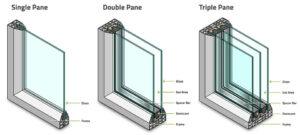
In Colorado, yes. A triple-pane insulated glass unit traps two layers of argon or krypton gas instead of one, which roughly doubles the insulating value of the glass area itself. In a climate that swings from sub-zero winter mornings to 95-degree summer afternoons, that extra insulation pays back in lower heating and cooling bills year-round.
The catch with triple-pane is that it’s typically a paid upgrade on a national-catalog window, not the default spec. The Ameritech hybrid runs triple-pane as the standard build because it’s what makes sense for this market. For a deeper look at the tradeoffs and the actual ROI math for Front Range homes, our triple-pane windows guide for Colorado walks through it in detail.
Side-by-side spec comparison
The honest comparison, by specification:
| Specification | Ameritech Hybrid | Big-Box Catalog (Value Tier) |
|---|---|---|
| Frame construction | Vinyl exterior + composite core | Hollow vinyl |
| Standard glass package | Triple-pane + Low-E + argon | Double-pane + Low-E |
| Warranty (frame + glass) | 40 years | 10 to 25 years |
| Sizing model | Made-to-order to opening | Catalog sizes, trim to fit |
| Designed for | Colorado high-altitude UV + freeze-thaw | National catalog |
| Typical U-Factor | 0.20 to 0.24 | 0.27 to 0.32 |
| Dark color warranty | Full coverage | Often limited or excluded |
Premium tiers from the major catalog brands close some of these gaps. Triple-pane is available as an upgrade. Better warranties are offered on premium lines. The composite-core construction is rarer. Even when you spec up to a premium tier at a big-box retailer, you’re typically paying a similar price to a Colorado specialist’s standard build, without the climate-specific engineering.
What to ask before you buy
Whether you’re shopping a big-box retailer, a national chain, or a local specialist, these are the questions that separate a good window from a label that sounds good:
- What’s the U-Factor? Lower is better. For Colorado, look for 0.27 or below on a standard build, 0.24 or below on a premium build.
- What’s the SHGC (Solar Heat Gain Coefficient)? On south- and west-facing windows in Colorado, you generally want 0.25 to 0.40 to take advantage of free winter sun without overheating in summer.
- Is the frame solid or hollow? Composite, fiberglass, and wood-clad are denser and more dimensionally stable than hollow vinyl.
- How long is the warranty, and what’s excluded? Read the dark-color and heat-distortion clauses specifically.
- Is the window made-to-order or trimmed to fit? Made-to-order seals better and lasts longer than a catalog window shimmed into the opening.
- What’s the standard glass package? Triple-pane standard is rarer and worth knowing about up front.
Frequently Asked Questions
Are Home Depot windows good quality?
It depends on which brand and tier you choose. Home Depot stocks windows from several reputable manufacturers across value, mid-range, and premium product lines. Premium-tier options can be genuinely strong. Value-tier options are designed for affordability rather than long service life in extreme climates. The key is to compare the actual specifications (frame construction, U-Factor, warranty terms, dark-color exclusions) rather than the brand name, and to confirm what’s included as standard versus a paid upgrade.
Why are Ameritech windows different from what Home Depot sells?
The biggest difference is frame construction. Our standard window uses a vinyl exterior bonded to a structural composite core, which is uncommon in the big-box catalog. The composite core prevents the warping and seal failure that hollow vinyl can develop over a decade of Colorado UV and freeze-thaw. We also run triple-pane glass and a 40-year warranty as the standard build, where most catalog windows treat both as upgrades. Made-to-order sizing instead of catalog-size-plus-shimming rounds out the differences.
How much do replacement windows cost in Colorado?
Installed cost per window ranges from about $400 to $500 for a basic vinyl unit at the low end up to $1,200 to $2,000 for premium custom windows. A typical whole-house replacement project for a Front Range home runs $8,000 to $30,000 depending on the window count, size, frame material, glass package, and any structural reinforcement needed. The biggest cost drivers are the glass package (triple versus double-pane), the frame material (hollow vinyl is the cheapest, composite and wood-clad cost more), and any custom sizing or structural modifications.
How long should replacement windows last?
A well-built window installed correctly should last 25 to 40 years in Colorado, depending on the frame construction, the glass package, and the install quality. Hollow vinyl windows in this climate typically need replacement around year 15 to 20. Composite and fiberglass frames stretch that timeline to 30 to 40+. Premium wood-clad windows can last 40+ years with proper maintenance. The frame is what fails first in most cases. The glass package usually outlasts the frame’s structural integrity.
What’s the most energy-efficient window for a Colorado home?
The most energy-efficient window for a Colorado home combines a low U-Factor (0.24 or below), an SHGC tuned to your exposure (typically 0.25 to 0.40 on south and west, lower on east and north), triple-pane glass with Low-E coatings, an argon or krypton gas fill, warm-edge spacers, and a frame material that stays dimensionally stable in extreme temperature swings (composite, fiberglass, or wood-clad outperforms hollow vinyl). The frame and glass package together drive the energy performance. Picking one without the other gives you incomplete savings.
The bottom line
The catalog windows at a big-box retailer can be fine for the right home in the right climate. In Colorado, the construction that holds up best over a 30 to 40 year horizon is a composite-core frame with triple-pane glass, designed for the altitude and the freeze-thaw cycle this region actually has. That construction is what we install at Ameritech as our standard build, not as an upcharge.
If you’d like to see the hybrid window in person, get an in-home assessment of which spec actually fits your house, and a no-pressure quote, contact Ameritech Windows or call (303) 586-6091. We’ll bring samples, walk through the specs honestly, and let you decide.
GET FREE QUOTE!
Promo Ending Soon 10-01-2026
Locally owned and operated in Colorado for over 30+ years
Minimum purchase does apply and cannot be combined with any other discounts.*
Deal is for first time customers only.**
By submitting this form, I verify that the number provided is my mobile telephone number and I provide my express written consent for Ameritech Windows to contact me at this number via phone, email, and text message (SMS) using automated dialing technology for marketing purposes. I agree to the Terms and Conditions and Privacy Policy. Consent is not a condition of purchase. Message and data rates may apply. To opt out at any time, you may reply STOP to any text message or notify Ameritech Windows by telephone.